
17 Local SEO Strategies for Real Estate That Drive Leads
Blogs, Real Estate
- Author: Rahul Shivaprakash

Introduction
The UAE real estate sector operates in a high-supply, high-competition environment. Visibility is constructed deliberately, and search has become its primary point of origin.
When someone searches for a property in a specific area, they are not browsing. They are evaluating. This is where real estate SEO stops being a marketing function and starts becoming a business driver.
Local search, in particular, has changed how demand is captured. Buyers today don’t just look for “apartments in Dubai”—they search for “apartments in Downtown with ROI potential” or “family villas in Arabian Ranches.” The intent is specific, and so the visibility must be equally precise.
The brands that win are not the ones that appear everywhere. They are the ones that appear exactly where it matters.
Meet the team behind the strategy
What Is Local Real Estate SEO?
At its core, real estate local SEO is about ensuring your brand shows up when someone searches for property within a specific location. But in practice, it’s far more layered than that.
It is not just about ranking; it is about relevance.
Local SEO for real estate agents and developers involves:
• Aligning content with location-specific intent
• Building authority within micro-markets
• Creating signals that search engines associate with trust and proximity
Unlike broad SEO, which focuses on scale, local SEO for real estate agent visibility is about precision. It’s about owning specific geographies—Downtown, Dubai Marina, Jumeirah Village Circle—not just the city.
Why Most Real Estate Businesses Fail at Local SEO
Most real estate brands invest in SEO. Few see meaningful results.
The reason is not effort—it’s approach.
Common patterns include:
• Treating SEO as a technical checklist rather than a strategic layer.
• Creating generic pages that lack location depth.
• Over-relying on portals instead of building owned visibility.
• Ignoring how buyers actually search.
In many cases, SEO for real estate agents becomes fragmented—handled in isolation, without alignment to sales strategy or buyer behavior.
The result? Visibility without relevance. Traffic without conversion.
The 5L Framework to Win Local Real Estate SEO
Location Targeting (Hyperlocal Keywords)
Search behavior has evolved from broad to hyperlocal. Buyers don’t search cities—they search communities, towers, even street-level nuances.
A strong SEO strategy for real estate begins with understanding:
- Market shifts explained in simple, relevant terms
- Short-form videos highlighting lifestyle districts in Dubai or Abu Dhabi
- Insights into emerging investment zones
Owning “Dubai real estate” is difficult. Owning “waterfront apartments in Dubai Marina with rental yield” is strategic.
Listings Optimization
Listings are often treated as inventory displays. In reality, they are search assets.
Optimised listings go beyond specifications. They:
- Reflect how users search
- Integrate location relevance naturally
- Provide clarity, not clutter
For any real estate SEO company, listings are not just pages—they are entry points into the funnel.
Local content engine (Area + lifestyle pages)
Generic blogs rarely move the needle.
What builds authority is content that reflects real decision-making:
- Area guides that go beyond surface-level insights
- Lifestyle narratives that help buyers imagine living there
- Investment-focused content that answers ROI questions
This is where local SEO services become less about keywords and more about context.
Link Authority (PR + Backlinks)
Search engines do not just evaluate content—they evaluate credibility.
Local authority is built through the following:
- Coverage in regional publications
- Mentions across relevant platforms
- Contextual backlinks tied to location and expertise
In competitive markets, authority is rarely self-declared. It is referenced.
Lead Conversion (Turn Traffic into Inquiries)
Ranking is only half the equation.
Without conversion, visibility remains passive.
- Pages guide users toward action
- Messaging aligns with intent
- The journey from search to enquiry feels seamless
Traffic without direction rarely converts.
See how we approach local SEO for real estate
Keyword Strategy for Local Real Estate SEO
A strong keyword strategy is not about volume—it’s about alignment.
In the UAE, search intent varies significantly:
• Investors search differently from end-users
• International buyers search differently from residents
• Off-plan queries differ from ready property queries
An effective SEO for real estate agents approach considers:
• Intent layers (research vs decision)
• Location specificity
• Commercial relevance
Keywords should feel embedded, not inserted.

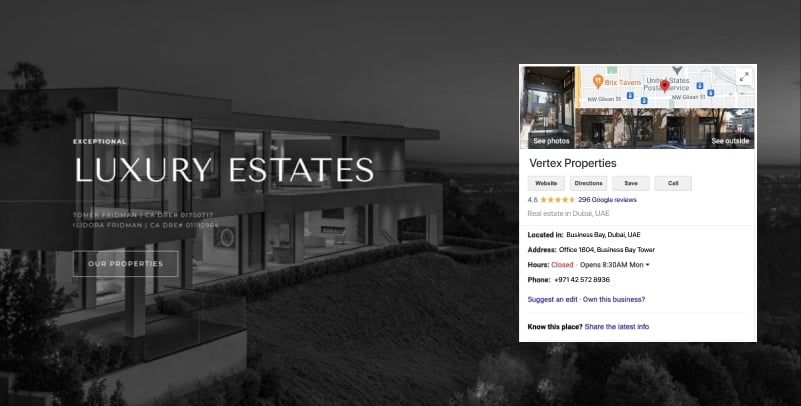
Google Business Profile That Drives Calls, Not Just Views
For many real estate businesses, visibility on maps is underutilised.
A well-managed profile can become a consistent lead source—but only when treated as an active asset.
Optimisation:
Clear categories, accurate location data, and consistent updates improve discoverability.
Review Strategy:
Reviews are not just feedback—they are trust signals. Structured, consistent review collection builds credibility over time.
Posting strategy:
Regular updates such as new projects, market insights, and key shifts help show that the business is active and engaged.
Consistent activity also builds trust over time. It signals that the brand is present, aware of the market, and keeping information current, which matters when buyers are evaluating options.
For local SEO for real estate agent visibility, this usually becomes the first point of interaction.
Build Local Authority with Content
Authority is not built through volume—it is built through relevance.
Instead of generic blogs, focus on:
• Detailed area guides
• “Best places to live in…” narratives
• ROI-driven insights
• Lifestyle-led storytelling
This type of content reflects how buyers think.
A strong real estate SEO company understands that content is not just for rankings. It is for positioning a brand in the market.
Good content usually shapes how a developer, broker, or agency is perceived before any direct interaction.
In real estate, where buyers compare carefully and take time to decide, content usually becomes the first filter. So the focus is not only visibility, but clear and consistent positioning that reflects value and intent.

AI & Voice Search in Local SEO
Search is becoming more conversational.
Queries are longer, more specific, and usually voice-driven:
• “Best family communities in Dubai with schools nearby”
• “High ROI apartments in Business Bay”
This shift needs content that:
• Answers questions clearly
• Uses natural language
• Anticipates follow-up queries
AI is not replacing SEO; it is refining how content is discovered and interpreted.
Local Link Building That Builds Trust
Links are still one of the strongest signals of authority—but quality matters more than quantity.
Effective approaches include local PR coverage that helps a brand get noticed through trusted media mentions and stronger market visibility. It is not just about being seen, but being seen in the right places.
Strategic partnerships also matter. Working with aligned businesses naturally builds credibility and strengthens trust within the wider ecosystem. It shows that the brand is connected and relevant within the market.
Along with this, listings in credible directories help maintain a steady presence across reliable platforms. This enhances how easily the brand is found and adds a layer of trust for people searching locally.
Thus, for real estate local SEO, links should reinforce location relevance.
From Rankings to Real Estate Leads
The real objective is not ranking—it is conversion.
This needs:
CTA Frameworks:
Clear, non-intrusive prompts aligned with user intent.
Landing Pages:
Focused, location-specific, and built for clarity.
Lead Magnets:
• Area reports
• Investment guides
• Market insights
A strong seo strategy for real estate ensures that every page has a purpose beyond visibility.

Common Mistakes That Impact Local SEO Performance
Even well-funded strategies fail due to small but critical gaps:
• Keyword stuffing that reduces credibility
• Weak location pages lacking depth
• Ignoring mobile optimisation
• Treating SEO as isolated from brand positioning
In most cases, the issue is not lack of effort—it is lack of alignment.
Read more insights on real estate marketing
Conclusion
Local search is no longer a supporting channel—it is central to how real estate demand is captured.
For developers, brokers, and marketing leaders, the question is not whether to invest in SEO, but how strategically it is approached.
A well-executed real estate SEO agency approach does not just improve rankings; it builds long-term visibility, credibility, and consistent enquiry flow.
Mint & Co. approaches this not as a campaign, but as a system—where content, search, and brand positioning work together over time.
Let's build your local SEO strategy — talk to our team
Got Questions? We've Got You.
How do I optimize Google My Business (GMB) for real estate in Dubai?
Focus on accuracy, consistency, and activity. You must ensure your profile reflects your services clearly, collect reviews consistently, and post updates that reflect ongoing projects and market insights.
How does on-page SEO work for Dubai property listings?
It involves aligning listing content with how users search—integrating location relevance, clear structure, and meaningful descriptions rather than just specifications.
How to get local backlinks for real estate in Dubai?
Through local PR, partnerships with relevant platforms, and inclusion in credible directories. The focus should be on relevance and authority, not volume.
Tags: Get Leads, leads, Real Estate
Related articles

Real Estate Development PR: How Developers Launch Projects
Blogs, Real Estate

Real Estate Developer Marketing: The Complete Guide
Blogs, Real Estate

How to Build a Real Estate Development Marketing Plan
Blogs, Real Estate

10 Real Estate Development Marketing Strategies (2026)
Blogs, Real Estate

RERA Advertising Rules 2026: Developer Compliance
Blogs, Real Estate

Trakheesi Permit: Clear It Before Your Dubai Campaign
Blogs, Real Estate