
Last Updated:
Why Real Estate Branding Matters and What It Means for Dubai Developers
Blogs, Real Estate
- Author: Rahul Shivaprakash
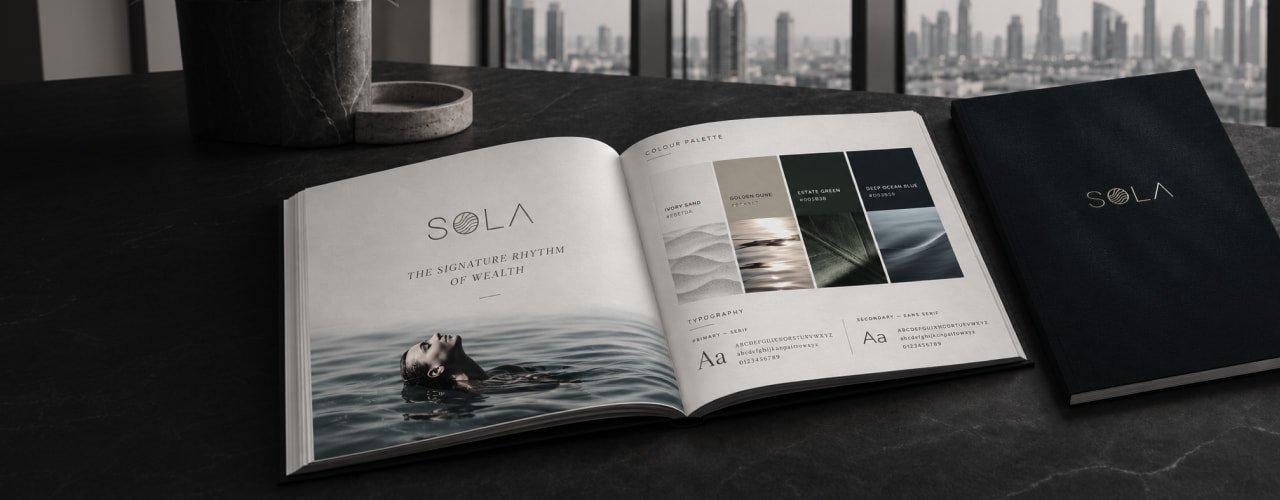
A buyer can admire a beautiful brochure and still hesitate to book. Real estate branding matters because a property purchase demands confidence in the people behind it. A credible brand can support premium pricing and help buyers move towards a decision, although neither outcome follows automatically. That is why branding is important in real estate: it gives buyers a reason to believe the promise.
The question feels particularly relevant in Dubai. Knight Frank reported that prices across ten prime neighbourhoods fell 5% between the second and third quarters of 2026, their first decline since 2020, according to Khaleej Times on 21 October 2026. That finding concerns the prime segment, not every Dubai property.
For developers, the practical question remains: why should someone choose this project? The answer involves identity, reputation and delivery. Here, we explore six reasons branding matters, how it has changed, the distinction between branding and brand affiliations, useful Dubai examples, and the mistakes that weaken an otherwise convincing proposition.
What Is Real Estate Branding?
A property brand is the promise, identity and experience buyers associate with a name. It takes shape through what a business says, what people recognise and what the business actually delivers.
- Developer brand: The reputation that connects a company’s projects and delivery history.
- Project brand: The particular idea, audience and character behind one development.
- Brokerage or agency brand: The expectations buyers attach to its advice and service.
- Agent brand: The expertise, conduct and communication people associate with an individual.
These levels should work together. A project can have its own personality while making its relationship with the developer unmistakable. Buyers should never need to untangle who builds, sells or manages the property.
Why Is Branding Important in Real Estate?
Branding helps buyers understand a development and decide whether its promise deserves their attention. Its commercial value grows when the building, sales process and ownership experience support the same idea.
1. It Builds Trust Before Handover
An off-plan buyer may commit years before collecting the keys. Delivery history, clear progress updates and a recognisable developer identity help them assess that uncertainty. A new developer needs credible evidence and candid answers; polished imagery cannot substitute for a track record.
2. It Supports Premium Pricing
Branded residences usually involve an association with a hospitality, fashion or other recognised brand. In Khaleej Times on 23 September 2024, Refine’s Thomas Wan cited premiums of up to 69% per square foot against non-branded homes in the same prime locations. This historical comparison does not isolate branding from design, services or other differences, and it does not establish a premium for every project.
3. It Makes Projects Stand Out in a Crowded Market
Knight Frank’s 2026 analysis counts 175 branded residence schemes in Dubai, comprising 68 live developments and 107 in the pipeline. Against that range of choices, a specific proposition helps: privacy, thoughtful family living or architectural distinction means more when the project can demonstrate it.
4. It Can Lower Marketing Costs Over Time
A familiar name gives the next launch an existing point of recognition. Reusable assets and returning audiences may improve efficiency, but cheaper enquiries are not inevitable. Track branded searches, repeat visits and acquisition costs across comparable campaigns before claiming that recognition has reduced spending.
5. It Builds Confidence with International Buyers
Someone researching from another country cannot inspect every detail in person. Matching information across the website, roadshow presentation and broker materials reduces avoidable doubt. Consistent branding across markets should preserve the central promise while adapting language and explanations for GCC, Asian and European audiences.
6. It Creates Reasons to Return and Recommend
The handover experience gives buyers something concrete to remember. Clear communication, responsive aftercare and well-run shared spaces can encourage referrals and repeat interest. A resident recommending a developer carries a different kind of credibility from another launch advertisement.
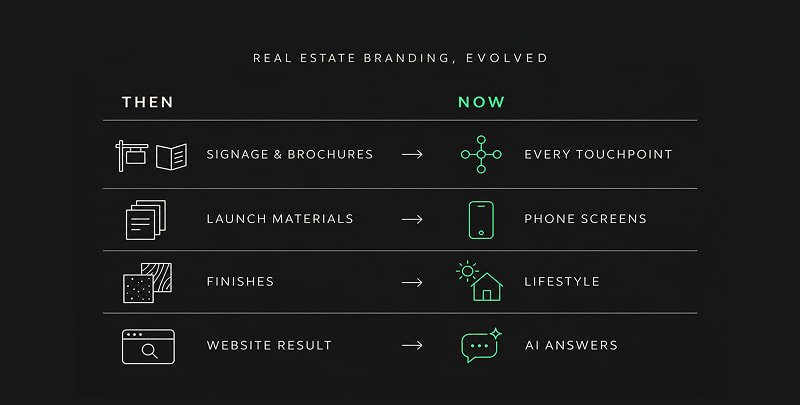
How Has Real Estate Branding Changed?
The logo still matters. It now has much more work around it.
- Then: Recognition centred on signage and brochures. Now: Every enquiry, update and handover contributes to the impression.
- Then: Launch materials carried the story. Now: Buyers may encounter the project through a phone screen long before visiting a gallery.
- Then: Luxury language often focused on finishes. Now: A convincing lifestyle proposition explains how residents will use the space and services.
- Then: Search visibility meant a website result. Now: Clear, verifiable information also matters when buyers consult AI tools, although no brand can guarantee inclusion in their answers.
The useful change is greater accountability. A promise becomes easier to examine when buyers can compare the brochure with public updates and residents’ experiences.
Branded vs Unbranded Real Estate — What’s the Difference?
The importance of branding in real estate extends beyond a famous name on a façade. A development without a hotel or lifestyle affiliation can still have an excellent brand. The comparison below concerns brand strength, rather than formal affiliation.
| Factor | Strong brand | Weak or unclear brand |
|---|---|---|
| Buyer trust | Offers recognisable, consistent evidence | Leaves buyers to resolve gaps and contradictions |
| Price per sq ft | Explains the value behind the asking price | May struggle to justify differences from alternatives |
| Sales speed | Can reduce uncertainty during consideration | May require more explanation and reassurance |
| Cost per lead | Recognition may improve efficiency | May depend more heavily on repeated paid exposure |
| Resale value | Reputation can contribute to future appeal | Gives future buyers fewer reputational reference points |
| Investor appeal | Presents a coherent proposition with supporting facts | Risks relying on broad claims and projected returns |
Swipe sideways to see the whole table →
These are possible effects, not performance forecasts. Location, supply, condition, service charges, pricing and market conditions remain material to the outcome.
Talk to Our Team About Branding Your Next Development
What Makes a Strong Real Estate Brand?
A practical real estate branding strategy begins with a choice: who is this development for, and what can it credibly offer them?
- Positioning: Identify a meaningful reason to choose the project, supported by its actual design and location.
- Name: Choose something memorable, pronounceable and suitable for the intended markets; check availability before committing.
- Visual identity: Build a real estate brand identity that remains recognisable across screens, signage and documents.
- Tone of voice: Decide how the business explains value, answers difficult questions and communicates delays.
- Brand book: Give staff and partners a usable real estate brand style guide covering language, imagery and approved applications.
- Customer experience: Make the enquiry, purchase and aftercare processes reflect the promise.
A real estate color palette belongs within that thinking. Colours can establish recognition; they cannot explain why a home suits its buyer.
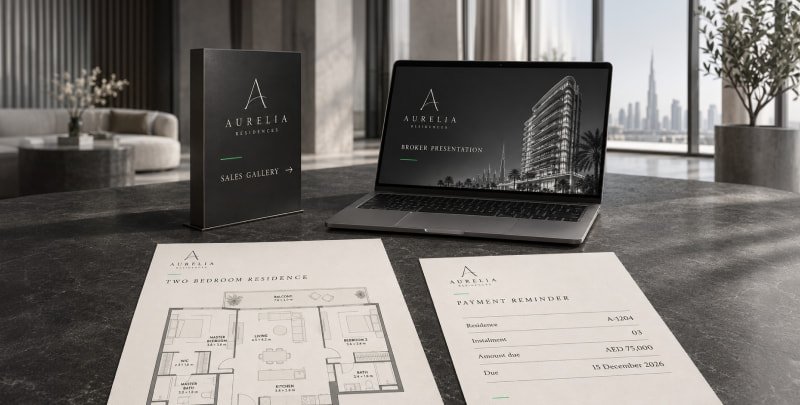
Before approving the identity, test it on ordinary materials: a floor-plan sheet, a payment reminder, a broker presentation. If the brand only works on the launch cover, the system needs more thought.
Book a Call to Plan Your Real Estate Brand Identity
Which Dubai Developers Offer Useful Branding Lessons?
These observations concern publicly visible positioning, not audited service quality or sales performance.
Emaar — A Sense of Place
Emaar’s website organises its offer around recognisable communities, including Downtown Dubai and Dubai Hills Estate. This presentation helps buyers place an individual home within a wider neighbourhood story.
OMNIYAT — Architecture as a Signature
OMNIYAT presents its portfolio through the language of art, architectural authorship and individual creations. The visible positioning gives its buildings a distinct cultural and design context.
Ellington — Design as a Consistent Theme
Ellington Properties foregrounds design in its public identity and residential presentation. The lesson is consistency: a central idea becomes more recognisable when a business keeps returning to it across its portfolio.
The opportunity for another developer lies in finding its own credible territory. Borrowing the appearance of these brands would miss the point.
What Branding Mistakes Do Real Estate Companies Make?
- Changing identity between channels. Give agencies and brokers one current asset library, with a clear approval owner.
- Copying the category’s favourite look. Define the buyer and proposition before choosing another gold monogram or skyline image.
- Starting only when launch materials become urgent. Set positioning early enough to guide naming, messaging and the sales experience.
- Ignoring brokers and buyer-facing staff. Equip them to explain the same facts and answer predictable questions accurately.
- Promising an experience operations cannot deliver. Review service claims with the people responsible for fulfilling them.
An inconsistency may look minor from inside the business. To a buyer considering a substantial commitment, conflicting specifications or an unanswered question can feel much larger.
Call Us for a Real Estate Brand Review
How Mint & Co. Builds Real Estate Brands
At Mint & Co., we bring brand strategy, identity, messaging and brand books together for real estate businesses. Our role as a real estate branding agency is to help developers and brokerages express a clear proposition, then carry it coherently through the places buyers encounter it.
We believe a strong identity should help a team make decisions. It should clarify what to say, what to show and which promises the business can stand behind. That gives creative work a commercial purpose without asking design to compensate for the property itself.
For further reading, explore our real estate branding ideas and perspective on branding in luxury real estate.
If your project has a clear point of difference but the story still feels difficult to tell, we would welcome a conversation about it.
Got Questions? We've Got You.
Why Is Branding Important in Real Estate?
It helps buyers recognise a business, understand its proposition and assess its credibility. The strongest identities draw support from actual delivery and consistent service.
What Is Real Estate Branding?
It is the work of defining and expressing the promise, identity and experience associated with a developer, project, brokerage or agent.
How Does Branding Help Developers Sell Projects Faster?
Clear information and a credible reputation can reduce uncertainty and repeated explanation. Sales speed still depends on the product, price, financing, demand and sales execution.
Do Branded Residences Sell for More in Dubai?
Some achieve premiums. The September 2024 comparison above reported up to 69%, but it is historical and does not establish a universal premium or isolate the effect of a brand name.
What Is the Difference Between a Developer Brand and a Project Brand?
The developer brand connects the company’s reputation across its portfolio. The project brand expresses the particular character and proposition of one development.
How Long Does It Take to Build a Real Estate Brand?
Research, approvals, naming and deliverables determine the initial timetable. Reputation develops over successive interactions and delivery milestones. Agree the scope before setting a launch deadline.
Tags: Get Leads, leads, Real Estate
Related articles
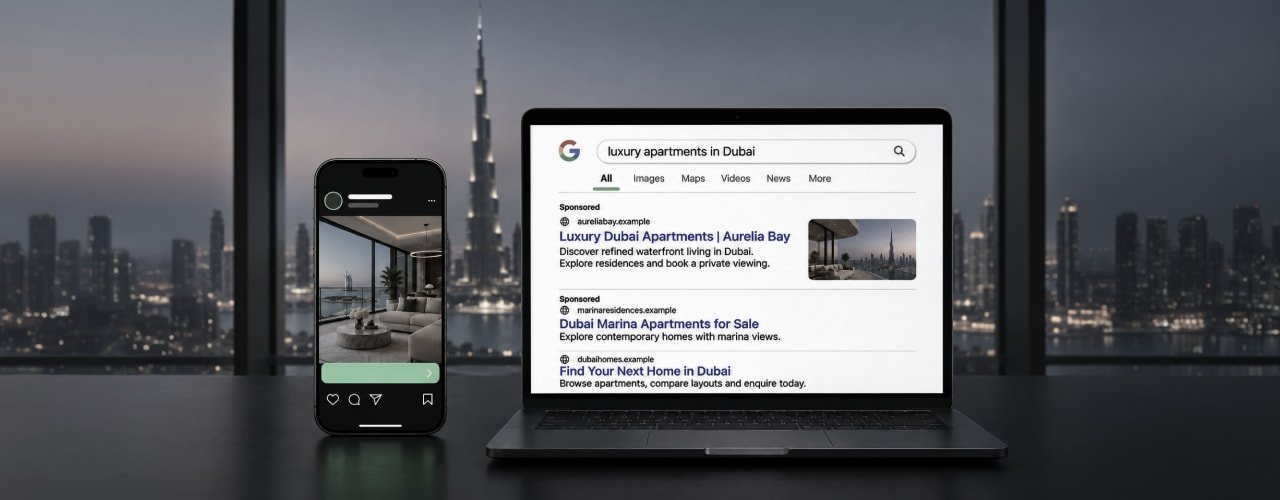
What Are the Best Converting Real Estate Ads for Agents in Dubai?
Blogs, Real Estate
How Can Developers Generate Real Estate Leads with Digital Marketing?
Blogs, Real Estate
12 Real Estate Social Media Post Ideas for Developers in 2026
Blogs, Real Estate
How Billboard Advertising Helps Real Estate Developers in Dubai
Blogs, Real Estate
Real Estate PPC Campaign Optimization: Strategies to Generate Quality Leads in Dubai
Blogs, Real Estate
How to Use a Virtual Tour for Real Estate: A Practical Guide for Dubai Developers and Agents
Blogs, Real Estate