
How to Build a Real Estate Development Marketing Plan
Blogs, Real Estate
- Author: Rahul Shivaprakash
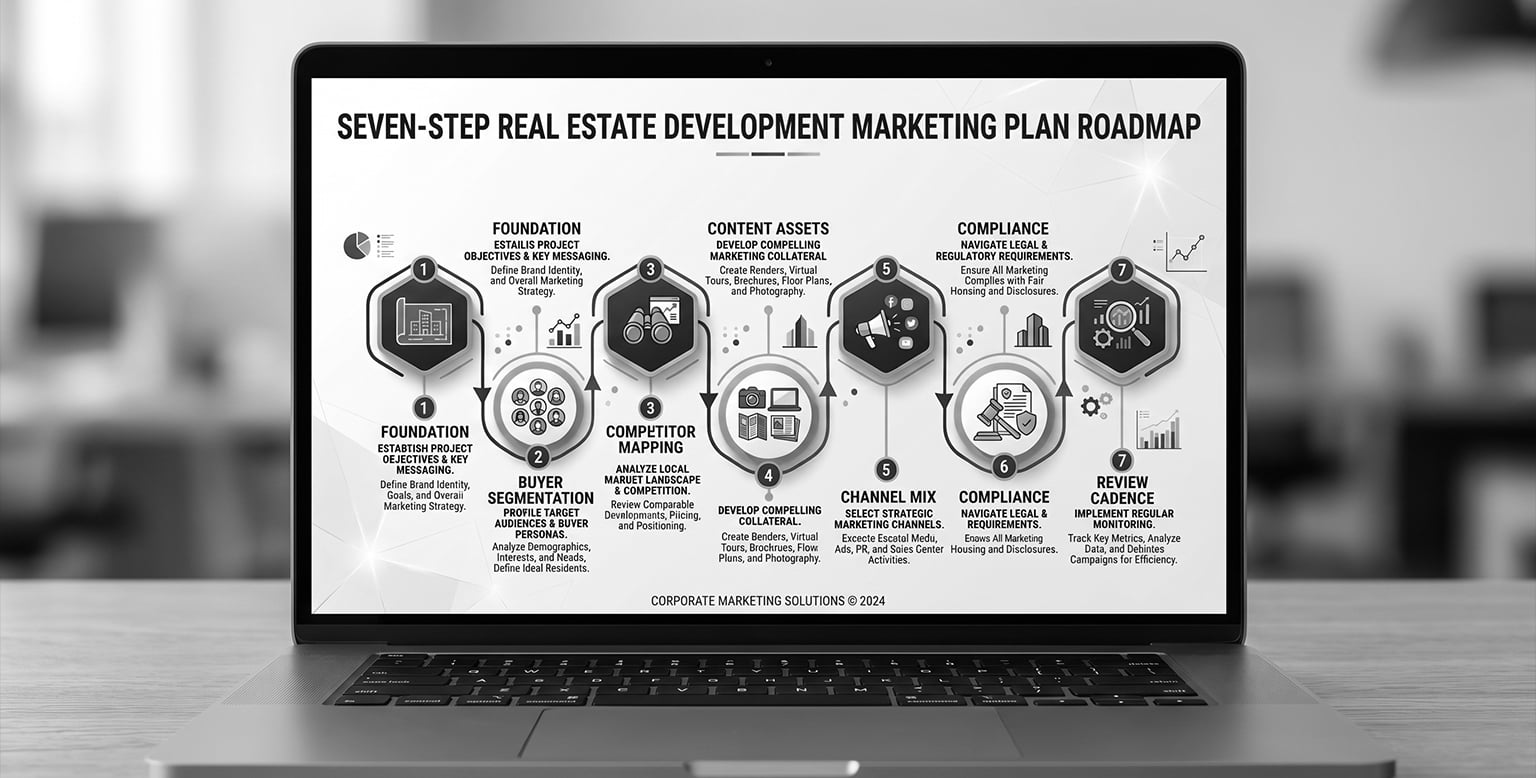
A real estate development marketing plan is the documented roadmap that sets a project’s positioning, budget, buyer segments, channel mix and timeline from pre-launch through sellout distinct from the marketing itself. Unlike an ad-hoc campaign brief, it gives investors, the board, brokers and agency partners one agreed view of the budget, responsibilities and timeline before any creative is commissioned.
For a developer, that distinction matters. A launch involves far more than advertising: positioning, buyer research, sales materials, digital visibility, broker activation, events, PR, compliance and lead management all have to move together. A written plan keeps those moving parts connected.
The seven steps are straightforward: establish the foundation, define buyers, map competitors, plan content and visuals, build the channel calendar, embed compliance, and create a review process that allows the plan to change as the project does.
Step 1: Set Your Foundation Positioning, Budget and KPIs
Before channels, campaigns or creative, the foundation of a marketing plan for real estate development should answer three questions: what is the project’s one-line positioning, what is the total marketing budget, and what will count as success?
Positioning should be clear enough to guide the website, sales deck, advertising and broker script. A real estate branding agency can help turn that positioning into a coherent brand system, but the marketing plan should establish the commercial direction first.
For UAE residential development, industry guidance commonly places marketing budgets around 2–5% of Gross Development Value (GDV), with newer or less established developers tending towards the higher end and established names with stronger market recognition potentially spending less.
The real estate development marketing budget should also be divided at a high level between pre-launch, launch and post-launch/sustenance from the beginning. The exact allocation can be refined later.
At this stage, the plan should set out the project’s core proposition, budget framework, channel allocation and the KPIs that will define commercial progress:
- One-line project positioning and core proposition.
- Total marketing budget, benchmarked against GDV and project requirements.
- High-level pre-launch, launch and post-launch allocation.
- Two or three headline KPIs.
- Cost per qualified lead.
- Sales velocity target.
- Broker-sourced conversion rate.
These numbers give every later channel decision a common commercial reference point.
Step 2: Define Your Buyer Segments
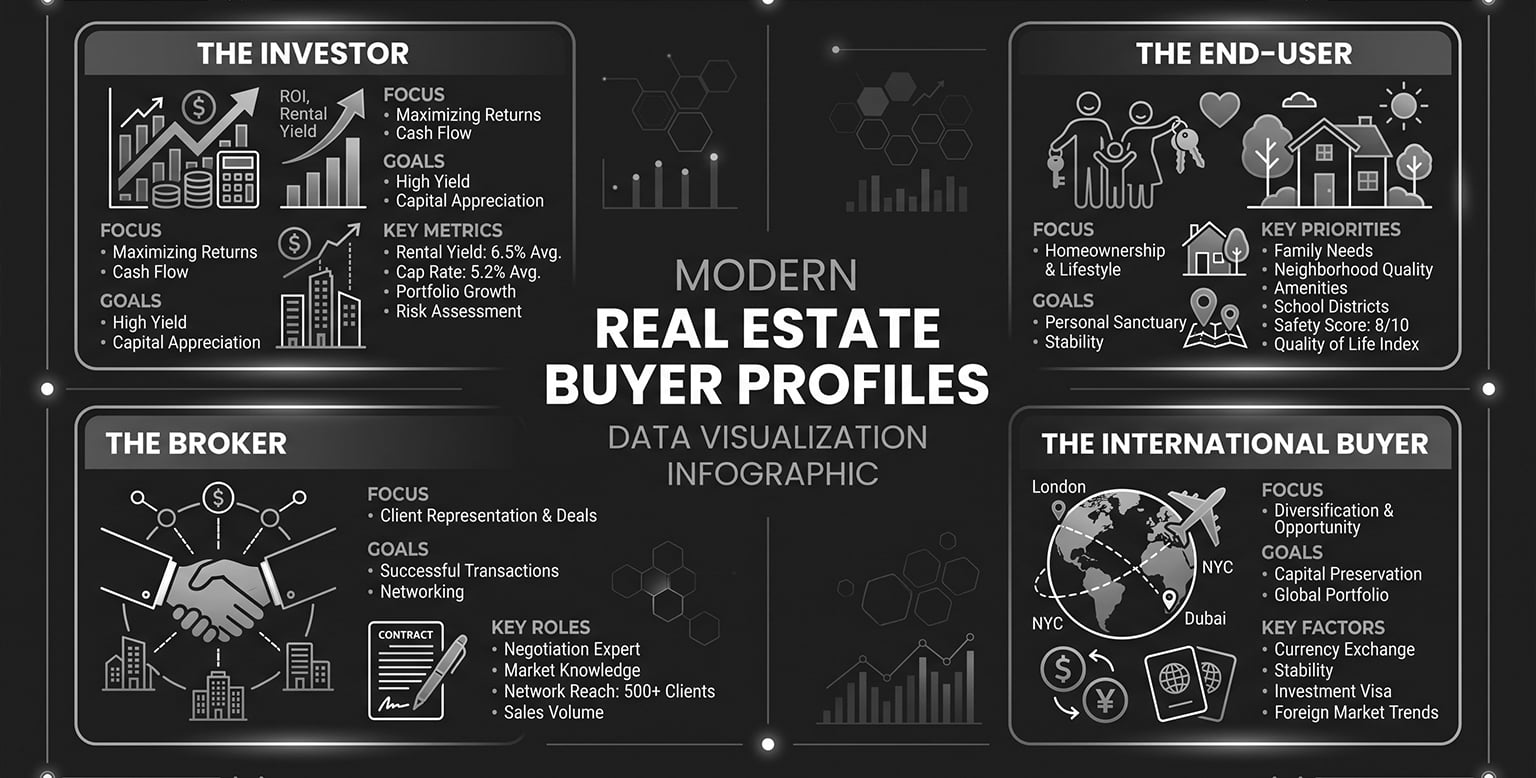
A development needs more precise segmentation than a single-property marketing campaign. Investors, end-users and the broker network each need different information, motivations and selling tools. International buyers should also be treated as a distinct audience where the project warrants it.
For each segment, write a short profile that can guide both messaging and channel selection.
A useful segmentation framework should cover:
- Investors: yield, payment plan, exit potential and market fundamentals.
- End-users: location, lifestyle, amenities, layouts and everyday usability.
- Brokers: commission clarity, inventory visibility, sales collateral and project facts.
- International buyers: language, market-specific content, remote buying concerns and relevant proof points.
- A decision on which audiences need dedicated content and which can share creative.
The international segment deserves particular attention in Dubai. Harbor Real Estate, citing DXBinteract data reported by Khaleej Times, identified Indian nationals as the largest international buyer group in early 2026 at an estimated 20.6%, followed by British buyers at 13.3% and Egyptian buyers at 12.6%.
That does not mean every development should target these audiences equally. It means the marketing plan for a real estate development company should make its audience assumptions explicit rather than treating “international buyers” as one broad group.
Step 3: Map the Competition and Sharpen Your Differentiator
This step should answer one question in writing: why should a buyer choose this project over the two or three closest competing launches in the same corridor?
The answer needs to come from a real competitive scan, not a brainstorm.
The competitive review should assess:
- Competing project pricing and payment plans.
- Positioning and core messaging.
- Amenities and product differences.
- Target audiences.
- Visible marketing channels and campaign activity.
- Strengths and weaknesses in competitors’ websites and sales material.
- A single differentiator statement that can guide creative, website copy and sales scripts.
Skipping this step is one of the easiest ways for a development to sound like every other launch in the same quarter. If five projects all promise “luxury,” “prime location” and “exceptional lifestyle,” those phrases stop doing useful work.
The differentiator should therefore be specific enough to influence decisions. It becomes the bridge between the marketing plan of real estate development and the actual message buyers encounter.

Step 4: Plan Your Content and Visual Assets
The content and asset plan should be built before channel spend. Every channel in the next step depends on having the right material ready; a launch calendar should not have to move because CGI production started late.
A typical development needs a core visual library before launch, with the sequence built around when each asset will actually be used.
The core asset set typically covers:
- CGI renderings for key spaces and hero unit types.
- A walkthrough film.
- An interactive floor-plan visualiser.
- Drone footage of the actual site and surrounding area.
- Photography for the sales gallery, website and brochure.
- Sales decks and broker collateral.
- Project and community content for the website.
- FAQs and investment-focused material.
Renders and floor-plan visualisers should exist before pre-launch teaser activity begins. If CGI virtual tours are part of the experience, production needs to be scheduled early enough for the assets to feed the website, social content, sales centre and launch campaign.
Plan Your CGI & Content Assets

Step 5: Choose Your Channel Mix and Build the Calendar
This is where the plan turns strategy, budget and content into a dated calendar. It should show which channel runs when, rather than simply listing the channels a developer intends to use.
Pre-launch
- Build the project’s website and landing pages.
- Start SEO and project content early through a real estate SEO agency.
- Begin organic social teasers.
- Start building search visibility before the main launch push.
Launch
- Activate paid performance campaigns and retargeting through a performance marketing agency for real estate.
- Coordinate the launch event through an event marketing agency.
- Time OOH placements to the same launch window through OOH advertising in Dubai.
- Align sales, broker and digital teams around the same project narrative.
Across all phases
- Use a real estate social media marketing agency as the daily content engine.
- Use a real estate PR agency to build third-party credibility.
- Add AI-driven lead qualification and routing through an AI marketing agency in Dubai, so high-intent enquiries can be directed to the right sales route rather than simply collected in batches.
The strongest plans do not treat channels as separate campaigns. Search should inform content. Content should support paid media. PR should strengthen authority. Social should reinforce the narrative. Sales feedback should feed back into all of them.
- Build the project’s website and landing pages.
- Start SEO and project content early through a real estate SEO agency.
- Begin organic social teasers.
- Start building search visibility before the main launch push.
Plan Your Channel Mix and Calendar
Step 6: Build In RERA and Trakheesi Compliance From Day One
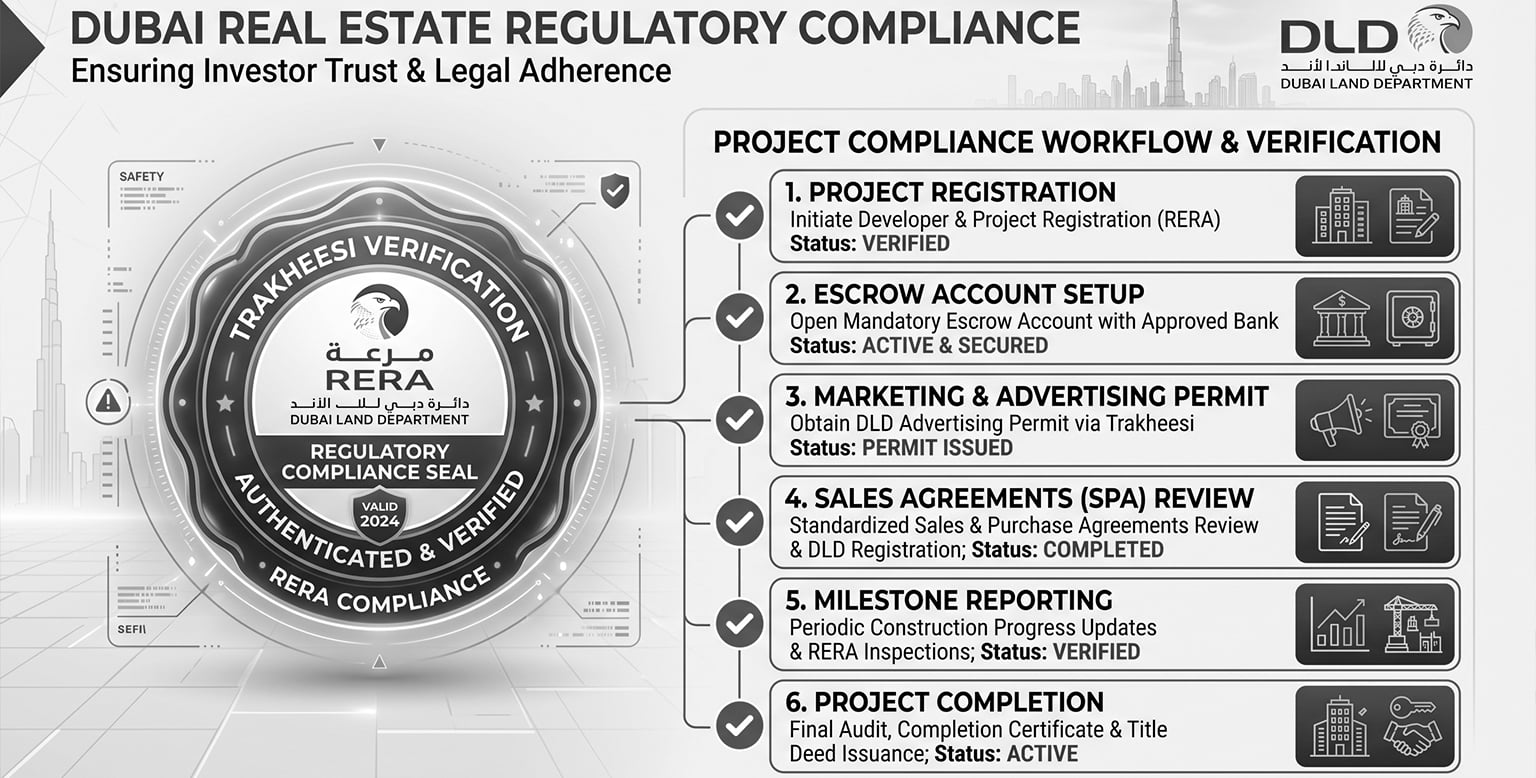
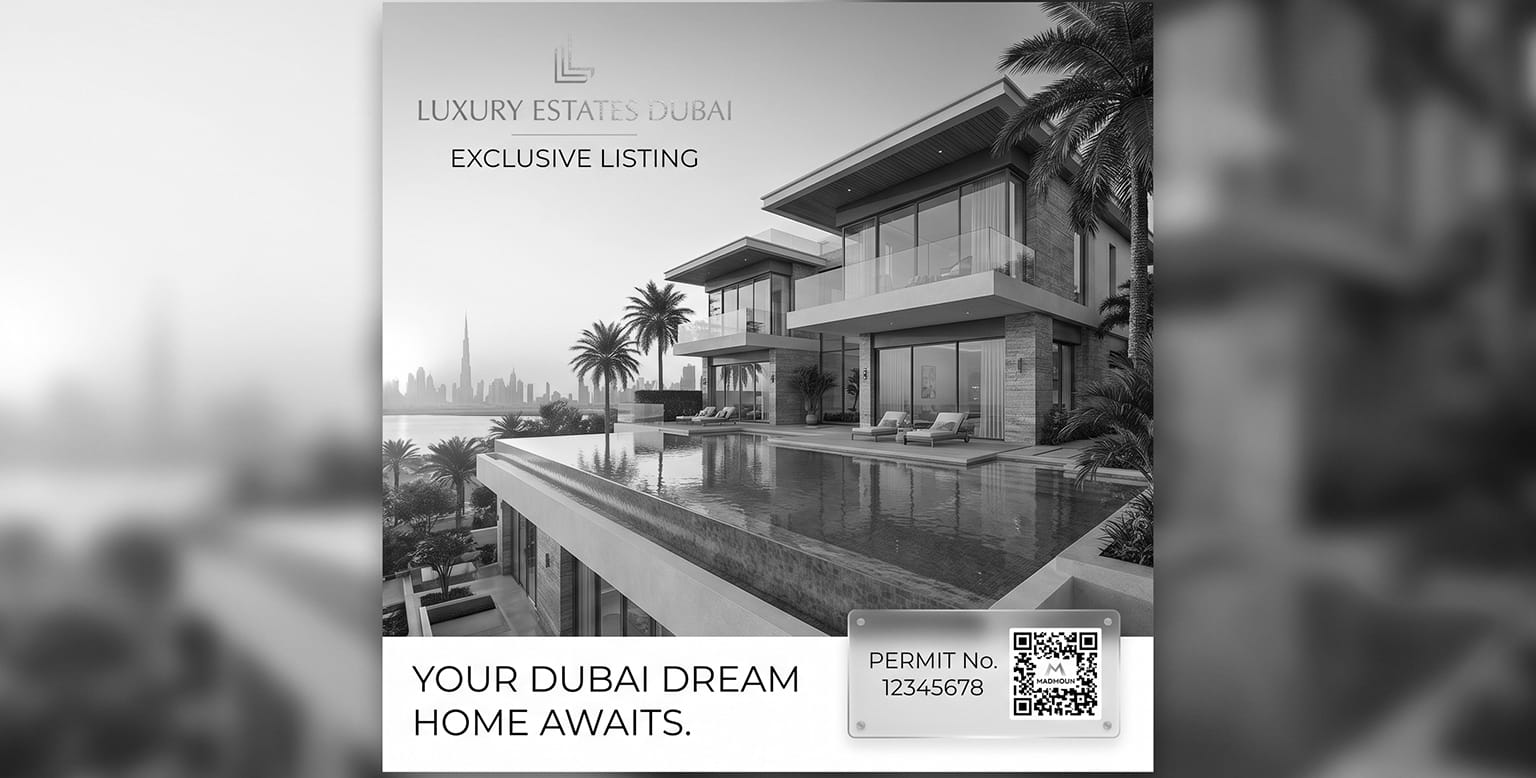
In Dubai, compliance belongs inside the marketing plan, not as a legal check bolted on just before launch. Real estate advertisements require the relevant permit through the Dubai Land Department’s Trakheesi system, while DLD guidance also makes clear that off-plan projects must complete registration and escrow requirements before marketing.
Include:
- Who owns the Trakheesi permit process.
- Permit deadlines against the creative calendar.
- Project registration and escrow status.
- A compliance review before any asset goes live.
- Checks on pricing, payment plans, project status and completion claims.
- Clear responsibility between developer, agency and legal/compliance teams.
DLD specifically states that developers should not market or promote projects before completing required registration procedures, opening an escrow account and obtaining the required marketing permit.
The plan should therefore make compliance a timeline dependency. Creative should not be fully approved only to discover that the campaign cannot legally run.
For a more detailed reference, see the RERA advertising rules.
Step 7: Set Your Review Cadence and Iterate
A real estate development marketing plan is a working document, not a one-time deliverable. The final step is deciding when it will be reviewed, which numbers matter and what will trigger a change in budget or channel allocation.
A practical review framework should cover:
- Weekly channel-level reviews during launch.
- Monthly full-plan reviews through post-launch.
- Cost per qualified lead.
- Sales velocity.
- Broker-sourced conversion rate.
- Lead quality, rather than raw lead volume alone.
- Defined rules for reallocating budget.
For example, if a channel misses its cost-per-qualified-lead target for two consecutive weeks, the plan can trigger a review or reallocation. That makes budget movement a rule-based decision rather than a reaction made under launch pressure.
Real Estate Development Marketing Plan Template: Quick Reference
| Step | Core Deliverable | Typical Timing |
|---|---|---|
| Step 1: Foundation | Positioning, budget and KPIs | Before any other planning |
| Step 2: Buyer Segments | Investor, end-user and broker profiles | Before creative brief |
| Step 3: Competitive Differentiator | Positioning and differentiation statement | Before creative brief |
| Step 4: Content & Visual Assets | CGI, floor-plan visualiser, photography and content | 8–12 weeks before launch |
| Step 5: Channel Mix & Calendar | Dated channel plan by phase | 6–8 weeks before launch |
| Step 6: Compliance | Trakheesi permit, escrow and RERA review | Parallel to Steps 4–5, before assets go live |
| Step 7: Review Cadence | KPI tracking and reallocation rules | Ongoing from launch through sellout |
Swipe sideways to see the whole table →
This real estate development marketing plan template is a practical starting point for a project of almost any size. The depth changes with the development; the order does not.
How Mint & Co. Helps Developers Build and Run the Plan
Mint & Co. is the Dubai agency developers can bring in to build the plan and execute it under one roof, rather than managing separate vendors for branding, CGI, SEO, performance, social, PR, events and OOH. The focus is simple: connect the commercial objective to the work happening across every channel, then keep that connection intact from positioning through sellout.
Our work can begin with the positioning itself through a real estate branding agency, extend into CGI virtual tours and real estate SEO agency, and continue through performance, social, events, OOH, PR and AI marketing.
The result is not simply a property development marketing plan sitting in a presentation. It is a working commercial system that connects the project, the buyer and the channels used to reach them.
Talk to Our Property Development Marketing Team
Got Questions? We've Got You.
What should a real estate development marketing plan include?
It should cover positioning, budget, buyer segments, competitive differentiation, content and visual assets, channel planning, compliance, KPIs and a review cadence from pre-launch through sellout.
How much should a developer budget for a real estate development marketing plan?
There is no universal figure, but UAE residential development guidance commonly places marketing at around 2–5% of GDV, depending on project scale, positioning, developer track record and market requirements.
What is a sample structure for a real estate development marketing plan?
A sample real estate development marketing plan can follow seven stages: foundation, buyer segmentation, competition, content and assets, channel planning, compliance, and ongoing measurement.
What are the 7 major components of a marketing plan?
The seven components are positioning and budget, buyer segments, competitive differentiation, content and assets, channel mix, compliance, and review and optimisation.
How long does it take to build a marketing plan for a new development?
A focused plan can be developed in a few weeks, provided the project positioning, commercial objectives, inventory and buyer assumptions are available. Asset production and compliance planning then need to run ahead of launch.
What's the difference between a marketing plan and a marketing strategy?
Strategy defines the direction who the project is for, how it should be positioned and how it should compete. The plan turns that strategy into budgets, channels, timelines, responsibilities and measurable actions.
How often should a developer review and update the marketing plan?
Channel performance should be reviewed weekly during launch, while the full plan should generally be reviewed monthly through post-launch. Major changes in inventory, pricing, competition or sales velocity should trigger an earlier review.
Tags: Get Leads, leads, Real Estate
Related articles

Real Estate Development PR: How Developers Launch Projects
Blogs, Real Estate
Real Estate Developer Marketing: The Complete Guide
Blogs, Real Estate
10 Real Estate Development Marketing Strategies (2026)
Blogs, Real Estate
RERA Advertising Rules 2026: Developer Compliance
Blogs, Real Estate
Trakheesi Permit: Clear It Before Your Dubai Campaign
Blogs, Real Estate

AI vs Traditional Marketing for Dubai Real Estate
Blogs, Real Estate